Tuesday, October 20, 2009

Class gift: Thank you, Ryan Frank

This post has almost nothing to with beer or brewing.

Lupe and Cady are the two women who run the office and coordinate many of the logistics at Siebel. Lupe's been at Siebel for 14 years and Cady, on and off, for nine, though now she's full time there as well. Lupe was the first person I spoke with at Siebel back in August when I called and made a desperate plea to get the final spot in the course. Hers was also the welcoming voice on the message that told me I had been accepted off the waiting list. Cady dutifully reminds us to wear name tags, makes us coffee in the morning, and returns our quizzes. She has the thankless job of collating our course binders each week. And, in a show of ludicrous commitment, she ran across the street to Goose Island one Thursday afternoon through the rain to deliver the final page of a study guide that one of the other students in the class had typed up. (The copier had gotten jammed during the first printing, and she fixed that too.) Cady joined us on our tours of Goose Island and during our German bier tasting as well. When we actually put together a class gift for Siebel, I'm going to push hard that we do something to honor them. In the meantime, they can also take credit for inspiring a lesser, though not unimportant, class gift that Fall 09 is leaving for Siebel.

In their time here, Lupe and Cady have seen plenty of brewers come through and so, it was with some definitiveness and experience that they proclaimed, "Oh yeah, most guys gain 15 to 25 pounds during the course." The responses from people were mixed--a little bit of resignation, a little bit of fear, a little bit of incredulity. But sure enough, their prophecy has proven true, and everyone (myself included) has fallen victim to the waist-expanding impact of free beers in our upstairs stube, Chicago's Italian beef, and sitting in a classroom all day, every weekday. Personally, I've tried to stave off the weight with long runs along the lake, and that's proved successful 90% of the time, which is really to say that my level of activity is better than nothing.
Enter Ryan Frank and a brilliant idea. Ryan is the class charmer--warm, nerdy (about beer), generally humble, extroverted, and always (always) willing to go out after class. For those of you who might understand, he's a little bit Geoff Barrows, a little Cooper Sanford, a lot of Eric Meizlish circa 2001 and a dash of Laura Yale, which is to say, a he's willing to join in on any crackpot plan you can think up. All in all, a great guy to have in class and spend time with.

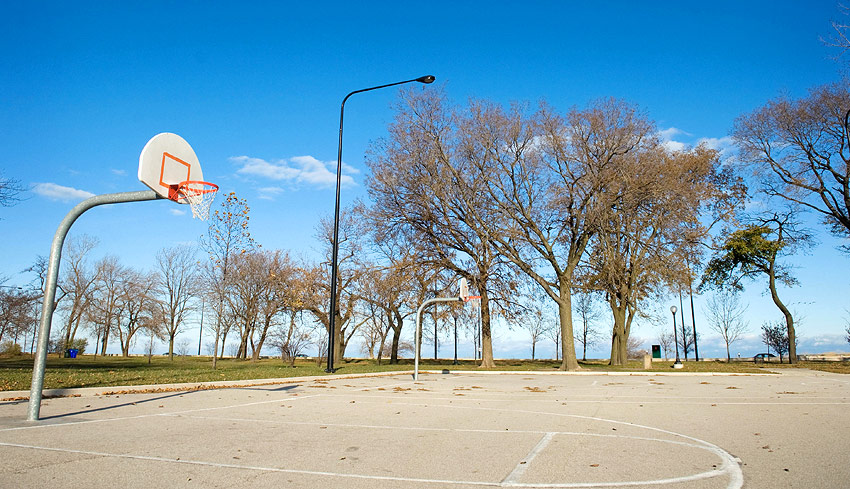
Anyhow, Ryan returned from lunch yesterday afternoon with a twelve dollar basketball that he had picked up during our hour off. It was time to start doing more than standing around and talking during our breaks and after class, he had decided. So by lunchtime today, nine of us found ourselves playing four-on-four on the basketball court next to school. For some, it was the most cardiovascular exercise they'd had since arriving in September ("My throat is still burning," Andrew Hood said after we had finished our game at lunch and been back in class for an hour). There was also a Goodwill Games element in the play, as many of the Mexican brewers from Grupo Modelo joined together on a team. We also found out that Patrick Zanello, our Brazillian brewer, is making a good faith effort to join the national team in time for the 2016 Olympics in case his brewpub in Rio doesn't pan out.

Balls bounced over the far fence under the L lines and across the fence near school through traffic on Clybourn, and brewers leaped fences (or attempted to) with a mid-day vigor hitherto unseen. My shooting percentage finished near 10%, and the rest of the brew squad was only a little further ahead (It did take us 25+ minutes to score six baskets, combined.) But, at day's end, people were so excited to get a little more exercise, that Team USA played Team Mexico one more round before the late afternoon light blurred the basket, all crepuscular-like.

I don't know that this counts as the calorie-burning pushandpull that we need to offset weeks of brew school, but it's sufficient escapism. Plus, the bold "Siebel Fall Class 09" label on the ball means that we'll bequeath at least a little to those future brewers who show up in Chicago next February. (Prime outdoor basketball season, I believe.) Until we gift more to Lupe and Cady, it will suffice.

Sunday, October 18, 2009

Our meme


My parents visited Chicago this weekend; it was great to spend time with them; amongst other things we took a tour of Half Acre Beer Co., visited a friend's mom's photography show at the Chicago Cultural Center, and walked around Millennium Park.

The highlight of the trip, though, may have been our dinner Friday night at The Publican, Chicago's top "beer and food" restaurant. Anyone's who's asked or given me the chance to tell them about the brewery concept that Danny, Jason and I have underway has heard my spiel about the niche that our pub will fill in the brewing world: there are breweries that serve great beer and decent (sometimes great) food, and there are excellent restaurants that have started focusing on their beer lists and beer/food pairings, but there is no brewery that has conceived itself as fully devoted to pairing its food to its beer and vice versa. Thus, our niche.

The interest in beer and food together has been growing steadily in the past few years. In Portland, Higgins Restaurant has been pushing its beer list for ages. Garret Oliver, the brewmaster at the Brooklyn Brewery, wrote the seminal The Brewmaster's Table almost ten years ago. Cafe d'Alsace in New York grabbed headlines a year or two ago when they brought on a beer sommelier (now called a "cicerone" in the beer geek world). Lucy Saunders published The Best of American Beer and Food: Cooking and Pairing with Craft Beer in 2007. And the number of restaurants offering brewer's dinners has been growing steadily; in Chicago's foodie scene, The Publican is always cited as a top beer/food destination.

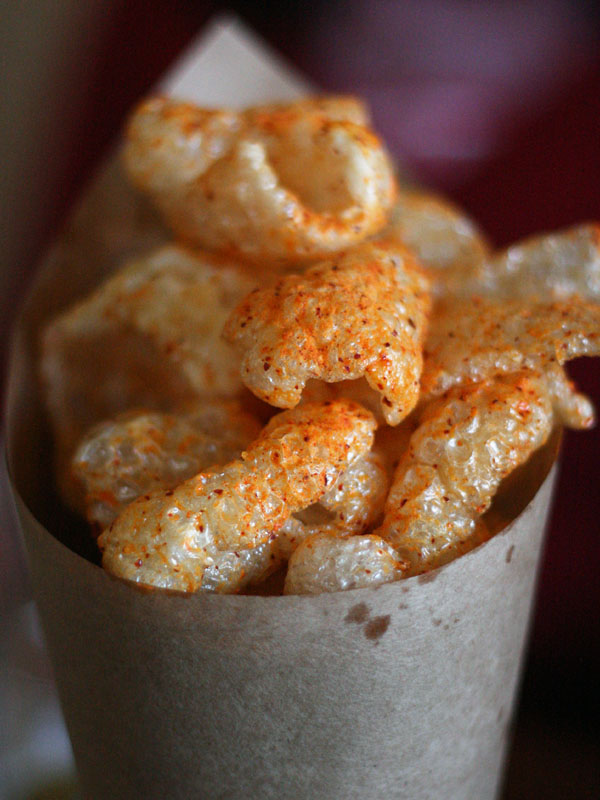
The beer list focuses primarily on Belgian and French ales, with a reserve of German, Scandinavian, British, and American beers as well. As an appetizer round, my parents and I split the ham platter, spicy pork rinds (the house specialty), and an apple salad that we paired with the St. Feuillien Saison. Given my mom's dislike for sweeter beers, I was concerned she might find the fruity esters of a saison to be overwhelming, so I was both nervous but also hopeful that the dry finish would be a palate pleaser. Saisons have a reputation of being a great "food" beer as they seem to go well with almost anything that's not overly sweet, and it turned out to be a great success! Both my parents liked the pairing, and I was especially impressed by how well the saison went with the pork rinds, complementing the light heat from the cayenne that they dust on.

The Publican is known for its pork dishes and hews to the "snout to hoof" method of carnivory, using as many parts of a pig in the dishes as possible. So the menu is awash in pork belly, head cheese, pork shoulder, tongue, and tripe. For our main dishes, my mom and I both took the cue from the large wooden pig sculptures that hang from the walls and ordered country ribs and pork belly, respectively. I deviated from the conventional wisdom of using a German beer and opted for one of the French biere de gardes on the menu. This time, the votes were split. Neither my mom nor dad cared for the beer, which was a little frutier, mustier, and earthier than the St Feuillien Saison. I thought it cut nicely through the richness and oiliness of my pork belly, but in hindsight, I might have opted for a lighter Belgian ale, like a wit, a lighter German festbier, or even something in the vein of Fat Tire, a hybrid Belgian pale/American amber, which has a really nice balance of malt and hops. I thought that the earthy flavors the biere de garde would be a crowd pleaser, though something a little more spicy seems like it would have been a more accessible accompaniment.

My dad ordered the walleye, and for his beer, I went out on a limb and ordered him an Orval. Orval is a Trappist beer--it's made by Belgian monks--and is sui generis in the brewing world: it is it's own style, and while a few American breweries have attempted to brew a New World version of it, no one has really matched it. What makes Orval unique is that it mixes some of the light caramel of a Belgian pale ale with a distinctive wild yeast character that is often described as lemony, leathery, and (the unfortunate descriptor) barnyard-like. Though he was taken aback when I described the beer as having a barnyard character ("Don't use that to sell your beer," he cautioned), my dad loved the Orval which was light enough to match a mild fish like walleye without overpowering it.

The food, the beer, and the company were all wonderful. The Publican, for its menu, beer list, atmosphere, and service, is almost exactly what I aspire our brewpub to feel like, albeit on a slightly smaller scale. Did I mention that they were packed with a youngish crowd all night Friday?

I was reminded about how much fun and how challenging it is to pair specific beers to specific dishes. Given that we're attempting to take on that challenge in developing the brewery, I imagine that the test brewing season will be labor intensive, involve lots of trial and error, require lots of feedback (I'm looking at all of those thirsty and hungry Portland folks who are willing to become trained tasters!), and, hopefully, lead to some brilliant pairs.

Wednesday, October 14, 2009

Yup, another brewery visit.

Our new "module" of class began this week, and we find ourselves focusing on the nuances of packaging and process technology. We've touched on everything from inspection technology on a bottling line to the materials used in brewery piping and insulation systems, to something called a Kerr Torquometer that measures whether screw-top bottles are appropriately closed when they leave the brewery. Recognizing that these types of technologies are better discussed and understood in person rather than in a classroom, our instructors led us over to the Goose Island Beer Co. production facility to see a major packaging brewery in action. And to have some beer, of course.

I mentioned Goose Island in my post about medal winners at the GABF. Between their two brewpubs (one of which is right across from school and gives us the equivalent of a "pro deal" in the craft brew world) and the production brewery, they are the brewery most closely aligned with the city of Chicago. They make a number of really excellent beers, and their higher end "Fulton" beers get better and better with each new release.

Since my last post detailed the progress of a typical brewery tour, I'll just mention some of the highights: tastes of uncarbonated Bourbon County Stout directly from a bourbon barrel and a little bit of Red Woody, the silver-medal award winning sour ale from the GABF that is extremely rare; an introduction to the computer software that Goose Island uses to manage the brewhouse; a visit to the lab and a chance to talk with their lead microbiologist about the new toys he has; and watching the shift crew clean out the diatomaceous earth filter right at our feet. Beyond those moments, though, there was something oddly nerve-wracking at work.

Having been to Flossmoor Station only two days previous, I found this brewery to be a study in contrasts. Other than New Belgium (where the tour generally eschews brewhouse technology in favor of anecdotes and praise for the company's green initiatives), this was the largest brewery I have ever visited. Goose Island's brewery produces 8 brews daily, fills 215 bottles per minute, and operates 24/7 about 360 days a year. The forklifts cruised past us carrying pallet after pallet of beer to the refrigerator. Now, compared to the really big players in the industry, this is still relatively small scale, but it is far larger than most American craft breweries ever get--they are the third largest craft brewery in the Midwest and a member of the Craft Brewers Alliance, a company controlled in part by Annheuser-Busch. The effect was intimidating, and I found myself awed by everything from the 5000+ sq. ft. cold storage, where no beer stays for more than three days, and all of the "big brewery" technology, like centrifuges and alcoholizers, that had existed only on the pages of brewing textbooks. I didn't know what half the pipes and hoses were for.

Earlier this summer, shortly after Danny, Jason and I finally committed that, yes, we were in fact going to move forward on starting our brewery, we passed by the main Widmer Bros. brewhouse in north Portland. It, like Goose Island, is massive. We joked, not completely facetiously, that we would one day have a place that size. Danny, Jason--I now realize that for that to come true, we'll all have to learn to drive (and probably maintenance) a forklift.

Sunday, October 11, 2009

I smiled the whole train ride back.

About twenty five miles south of downtown Chicago is Flossmoor, IL, a small bedroom suburb, that is known in the craft beer world as the home to the Flossmoor Station Restaurant & Brewery. The brewpub is actually located in the town's old train station, which abuts the current Metra Electric line stop. Flossmoor Station has been around since 1996, but it gained notice in the brewing universe when it took the "Small Brewpub of the Year" award at the 2006 Great American Beer Festival. If winning a medal at the GABF is like winning an Oscar for a film industry types, then that award is akin to winning Best Picture. It's the single-biggest honor bestowed upon a brewpub in the world. I visited Flossmoor in the summer of 2004 out of random chance, when I was in my sophomoric years of beer knowledge; today, I got to go back.

One of my classmates did an internship at Flossmoor last summer, and he arranged for anyone who wanted to to go down and get a tour with the head brewer there. Just after noon, I met Nick (the ex-intern), Joseba (one of the Mexican brewers in the course), and Adrian (the head brewer at the Bogota Beer Co), and we fought through the post-marathon crowds in downtown Chicago and got on a train to Flossmoor.

The trip south took a little over an hour, and as soon as we arrived, Bryan Shimkos, the head brewer and also a Siebel graduate, greeted us warmly. He let us settle in with some food and a sampler tray before starting the tour. The entire restaurant was packed--both the main bar area as well as the adjacent dining room. In Flossmoor, the brewpub was clearly fulfilling its purpose as the so-called "third place," in folks' lives.

The brewhouse abuts the main bar and is enclosed behind some floor-to-ceiling glass paneling; Bryan took us inside and joked, "I guess I should probably give you guys a more in-depth tour than I would to the normal crowds." "This is basically a glorified homebrew system," he explained, pointing out that all the grain is put into the mash tun manually and that their tool for dry hopping is a modified Lexan "Adventure Growler." The floor, which is the original pockmarked brickwork from the train station, is hardly ideal for a brewery and cleaning it sets the interns into a tizzy (as Nick pointed out).

Impressively, Bryan and his part-time assistant, whom we didn't meet, churn out enough beer on their 15 bbl system and four fermenters to keep 12 beers on tap and an ongoing bottle supply to the desirous Chicagoland market. He poured us some recently hopped amber ale from one of the fermenter's zwickels. It had the great mix of hops and crystal malt flavors of a solid American amber, and we got a few additional treats when we headed downstairs into their cold storage and barrel room.

In the basement, we sampled a several-year old bottle of De Wilde Zuidentrein, a sour ale made by Flossmoor Station's previous brewer (who now works in Eugene for Oakshire Brewing), which had lost some of its sharpness but still had a distinctive sour bite as well as Wooden Hell, a barleywine aged in bourbon-barrels from the distillery that makes Woodford Reserve bourbon. Wooden Hell is a rare and excellent beer; Bryan said he finds that it takes at least six months of aging time to get the coconut and vanilla flavors in a barrel-aged beer, and both those, as well as the classic dark fruit flavors and mild oxidation of a good barley wine were all present. It had a hint of woodiness that tasted almost dusty and grainy, which added to the complex flavors. It was a treat to get to try it and clearly a show of Bryan's generosity of his knowledge and beer with current and future brewers. He was also more than happy to answer all of our questions and talk shop about everything from the challenges of distributing in the Chicago market to the beers he had in barrels for Chicago's upcoming Festival of Wood-Aged Beer. Before long, we realized that we would have to run upstairs quickly to catch our train back north.

Revisiting Flossmoor threw into relief just how differently I approach and think about beer (and, well, my life) than I did in the summer of 04 when I was last there. At that point, I was just starting to really explore beer; today, I left re-affirming my belief that small-scale brewpubs can make world-class beers and thrive. The journey to get to that point is still both intimidating and seductive. And I'm not the only one that thinks so: Joseba admitted that Flossmoor Station is the type of brewery that he'd like to open in southern Mexico some day when he retires from brewing at Grupo Cuauhtemoc.

Thursday, October 8, 2009

Two types of motivation


Week 4 of beer school came with a wake up call and some exciting news.

The weekend finished, Monday and Tuesday's classes moved along at the same pace as we had come accustomed to during the first three weeks at Siebel. We reviewed our previous week's test on Monday morning and moved quickly into lectures on beer quality control--topics such as filtration, spoilage, and microbiology.

Tim Foley, one of our instructors, continued that same trajectory Monday morning with a lecture on carbonation techniques. Despite my deep, deep interest in beer, 90 minutes straight of lecture on CO2 is hard to handle, but Tim caught everyone's attention as he wrapped up his talk. "Let's take 15 guys and then Michael Eder will be here to tell you your itinerary for the European Study Tour." For weeks, one of our favorite games during lunch breaks had been to guess where in Europe we might go during the two week trip. Past groups had traveled round Germany, made pilgrimages to Pilsen and Prague, and occasionally visited Belgium. Where would we go? People's conjectures were a mix of logic and wishful thinking--ranging from the obvious choices in Germany to the up-and-coming gastropubs and artisan breweries in Italy.

From our seats in the classroom, Michael's spreadsheet, in a font around 3.5 pt, with tour sites, locations, and dates was hard to read. But with some squinting and collaboration, we were able to piece it all together. Starting November 23, we'll visit 5 countries and over 20 breweries. From Munich, we'll head north to Bamberg, home of rauchbier, then on to Dusseldorf. We'll cross into the Netherlands for a night in Amsterdam and a visit to both La Trappe (the only Trappist brewery outside of Belgium) and the real Heineken brewery. Then, on to Belgium for a few days, with trips to Achouffe, Duvel, and Cantillon. We'll make a quick stop in Luxembourg before returning to southern Germany, the Black Forest, and Salzburg. Lest you think that the trip will be all fun and games, we will have our final written exam looming over our heads once we return to Munich, but I'm sure we'll have more than our fair share of fun and learning while traveling.

By the time Michael Eder got to the end of his explanation of the tour, people in the room were gasping. A weekend in Brussels; a few days in the Austrian Alps; a visit to the home of smoked beer--this was a dream itinerary for beer lovers of any ilk. And who ever goes to Luxembourg? But our excitement was quickly sobered as he dove full on into a lecture on the minutiae of colloidal stability in beer (oxygen, warm temperatures, increased filtration time, and a balance of polypeptides and polyphenols lead to irreversible beer haze). And, more shockingly, Michael started asking people in the class questions directly.

"Just know that the German instructors aren't going to accept vague answers," we were told earlier in the week, and the admonition had quickly become a reality. "I want you to think about the entire brewing process," Michael told us after many of us had failed to answer his questions correctly. "We are talking about haze, but that does not mean that you shouldn't remember how to read a malt analysis."

It took less than an hour for the entire dynamic of the class to change. A Reinheitsgebot for the classroom. Now, not only did many of us have the intrigue of a European brew study tour ahead, but we were also suddenly held accountable, expected to have detailed information at our fingertips at any moment. I believe both those things will make us all better brewers.

Tuesday, October 6, 2009

Bogota's Next Big Thing, Michigan's Pride


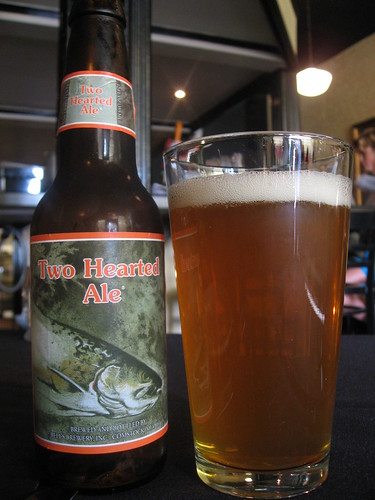
I just spent the last few hours watching the Tigers cement their month-long descent into regular season oblivion as they lost their Division Playoff to the Twins. Despite the jeers from Cubs and Sox fans, I was able to watch most of the game (from roughly the times the Twins fought back from a 3-1 deficit) at one of my favorite Chicago beer bars, The Local Option. Awash in disappointment with my hometown team, I found solace in something else from Michigan--Two Hearted Ale, the much-loved IPA from Bell's Brewery in Kalamazoo.

The Local Option carries the best selection of craft beer from Midwestern brewers in town, and Bell's beers are prominently featured. Despite a spotted history with distribution in the Windy City, Bell's is revered here, and it should be. Two Hearted won the inaugural Alpha King Challenge and is frequently copied by brewers around the country who want to make a solid IPA with lots of hop flavor and restrained bitterness. I've long argued that Two Hearted is the greatest IPA produced in the world and that it is also the best beer that one can buy in a six-pack in the world. Over time, my beer-curious friends who've traveled to the Midwest have found themselves converted. At this summer's end, some of my friends who had spent the summer in the Wisconsin Northwoods were sure to bring back a haul of New Glarus brews, but they made a special place for Two Hearted as well.

Since I've been in Chicago, I've seen my beer school friends fall for Two Hearted as well. Chuck, who's lived in New York, Connecticut, and Seattle, finally had his first taste tonight. "That's an incredible IPA," he said, conceding that it lived up to all of the hype he had heard in his years ignoring the "flyover states." Similarly, Adrian, our resident master brewer from the Bogota Beer Company, had one taste and said "Wow! How do they get those hops? This beer would be huge in Colombia. It's hoppy and sweet without being bitter. I want to brew it." And Dustin, who's a fellow Portlander, here in Chicago on loan from Laurelwood Brewing Co, said that he too was amazed that a beer that he had heard so much about could live up to its reputation.

What makes Two Hearted so great? It pours a transparent copper and tangerine with long-lacing head and good carbonation. The bouquet is dominated by hops, strong floral aromas that are assertive, though not overwhelming.

As for taste, Two Hearted has a clean, hop bitterness and is balanced by a crisp sweetness that imparts a remarkable, refreshing quality to the beer. Beyond this, it's the straightforwardness that strikes me again and again: this brew perfectly captures its style with a striking simplicity, and I can't imagine how it could be improved upon. Whereas many other IPAs or Double IPAs (and very good ones at that), strive for shocking levels of hops or a more complex palate, Two Hearted seems content to reveal itself quickly and cleanly and perfectly, again and again.

Two Hearted, unlike a wayward baseball team, never disappoints. In a head-to-head competition with Minnesota's best IPA (Surly's Furious), the MN offering tasted like an underhopped amber. And that decision--from me and my friends both--didn't require extra innings.

Sunday, October 4, 2009

The Medal Winners: Chicago's Beer Scene, Part Deux

Last weekend was the Great American Beer Festival, the annual showcase of American beer in Denver that brings together nearly 500 breweries, 49,000 festivalgoers, and more than 3,300 beers. The event is included in the book 1000 Things to Do Before You Die, and if you go to the festival, you're given a tasting glass and can sample away and try some of the most innovative beers in the world. It's also a competition, and winning a medal as a brewer at the GABF is akin to winning an Oscar as an actor--it's not why anyone goes into the job, but it's a pretty big deal.

Living in Colorado, I was lucky enough to go to the festival in 2005, 2006, and for two marathon sessions with Andy, my old homebrew partner, in 2007. The last two years I've been left to watch the results come in from afar, and Chicago's breweries pulled in an impressive seven medals this year. In fact, three breweries in the city brought home all three, so I took some time this week to go back and see what I thought (or re-thought) of the winning beers.

Rock Bottom is a national chain, the second largest "brewpub group" in the US. The Chicago brewery is the third largest brewpub in the Midwest, besting my favorite Fitger's Brewhouse in Duluth by about 15 kegs annually. The Chicago outpost of the Rock Bottom Brewery got two medals, one in the specialty category and one for its Belgian Rye Pale Ale "The Crow and the Sparrow." This latter medal is especially interesting because the category it won in "American-Belgo-Style Ale" not only requires an unnecessary amount of punctuation but also is one of the most recently developed styles. Brewers across the US are trying to take an American IPA and blend it with the yeast-derived scents typical of Belgian golden ales and tripels. Great Divide's Belgica is my personal favorite, and I was surprised to see it shut out of a medal. Getting to taste one of the winners made checking out Rock Bottom's version that much more enticing.

I made it to Rock Bottom twice in the past week, first to have a birthday beer with Jake Kessler and then with some of the brew school guys and instructors. The brewery is in a prime spot downtown, just north of the river, so it makes for a good gathering place on the weekends when we want to head out elsewhere in the city. After several rounds yesterday, the general consensus was that "The Crow and the Sparrow" was a good beer, maybe not the second best Belgian IPA in the US, and it does mix a lot of complex aromas between the hops, peppery rye, and clovey phenols from the Belgian yeast. The crowd favorite amongst the RB beers was Simcoe Smackdown! IPA, an India pale ale brewed entirely with the ultra-citrusy simcoe hop. The beer smelled and tasted like a grapefruit bomb, and it prompted many of us to start geeking out about what hop varieties will and won't remain popular in the next few years for craft brewers. Simcoe is sacrosanct for the time being.

Piece Brewpub also took home two medals. Piece is a frighteningly popular pizza-and-beer version of the classic American brewpub over in the Wicker Park/Bucktown area. I had heard about Piece for years because the pizza they serve is New Haven style, and I've long confessed that the one thing I miss about the East coast is being able to go to Sally's, Modern, and BAR. Last Thursday, I dragged Caroline McKenna out of her new apartment, and we slogged through the autumn rain over to Piece, where we ordered a pizza far too large (and a shockingly good take on a New Haven pie). As for beer, they were out of Fornicator, their lager which had won in the bock category, and I found the gold-medal winning hefeweizen to be too sweet for my tastes. Both Caroline and I opted for IPAs instead (a recurring pattern by now), which were unfiltered and had a nice balance between malt sweetness and a lot of piney hop aromas. We tasted a handful of other Piece beers that ran the gamut from average to solid. Many have a lot of residual sweetness that helps them pair well with the food, especially that delicious New Haven-style red sauce and that might be less appropriate if they were drunk without pizza as their co-pilot.

That leaves Goose Island, the local giant, who took home three medals this year. Goose Island has two brewpubs in Chicago, one of which is about two hundred feet from Siebel. Study sessions at "the Goose" are pretty common, so I was surprised that I hadn't had their biggest winner: the Goose Island IPA took the silver medal in the English-style IPA category. As we buckled down (seriously) to study for Friday's test on yeast, I found myself wowed by the floral hops and pronounced biscuity flavors in the beer. English IPAs are far less bitter than American versions, and Goose's gets that right. It took one sip before I was all smiles, and as it made the round for others to sample, the rest of the brew school boys had the same reaction. It was curious: for no good reason, I had assumed that Goose Island's "regular" beers were only so-so, and I was way off mark! Goose Island makes some other fantastic "big" beers and Belgian styles--Bourbon County Stout effectively kicked off the barrel-aging craze in the craft brew world, and Sofie (a saison with brettanomyces) is one of the best new beers of 2009, so it was a welcome surprise to see that one of Goose's flagship brews is just as good as their more outlandish brews.

Those three visits are as close as I'll get to the '09 GABF, and, while it's not like being in Denver for the real thing, I was more than happy to go and support the winners on their home turf. I'll continue to do so for the next month as well. Plus, I shouldn't fret missing the GABF too much--with any luck, I'll be pouring beer there come 2010.

Keep your fingers crossed; cheers!